











As businesses worldwide face growing pressure from resource scarcity, climate risks, supply chain disruptions and evolving sustainability regulations, the transition to a circular economy is no longer just an environmental ambition. It is becoming a strategic business priority.
The Global Circularity Protocol for Business, Version 1.0 offers a timely and practical response to this need. Developed as a voluntary global framework, the Protocol provides organizations with a standardized approach to measure, manage and communicate circular performance across their operations and value chains. It is designed for businesses of all sizes, sectors and geographies, from multinational corporations to small and medium-sized enterprises.
At its core, the Protocol helps companies understand how materials enter, move through and leave their business. It supports organizations in identifying where resources are being used inefficiently, where waste is generated, and where circular opportunities can be created. These opportunities may include increasing the use of recycled or renewable inputs, designing products for durability and repairability, extending product lifetimes, improving recovery systems, and reducing dependence on virgin resources.
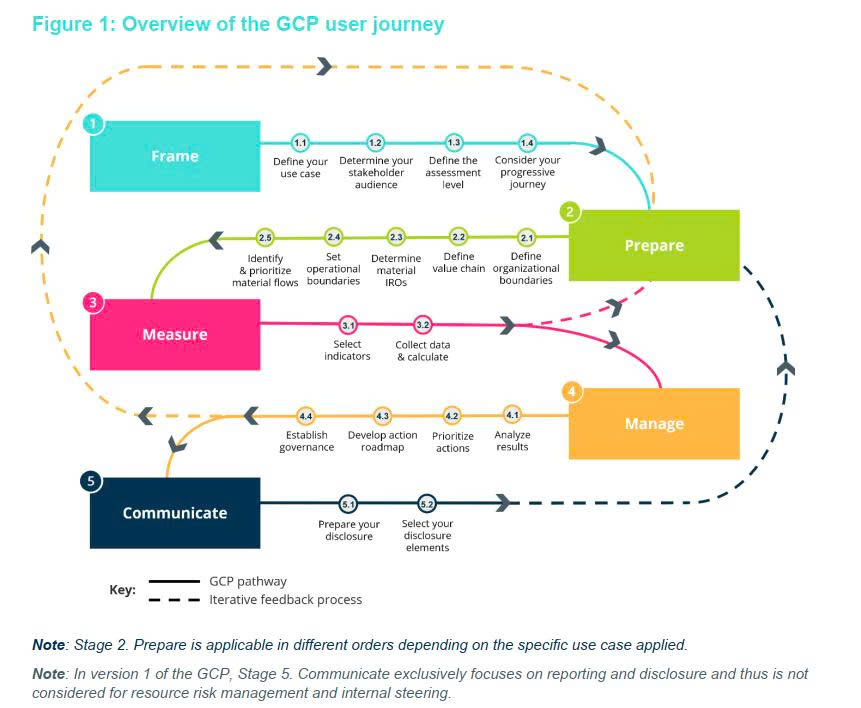
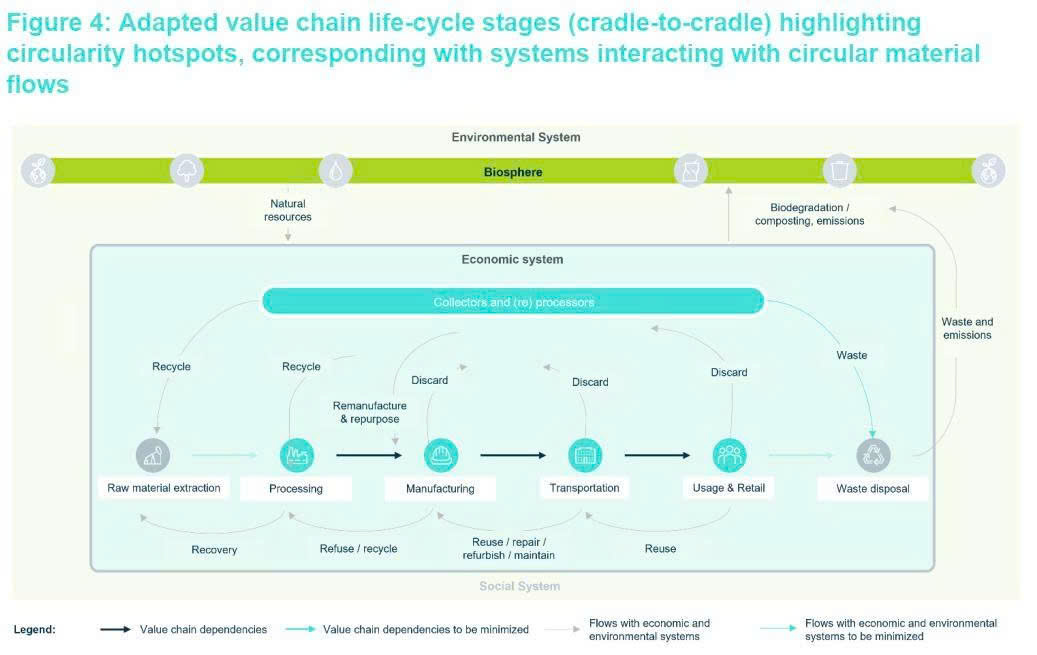
The GCP guides businesses through a clear five-stage journey: Frame, Prepare, Measure, Manage and Communicate. First, companies define their objectives and use cases, such as managing resource risks, improving internal decision-making or reporting to external stakeholders. They then map their value chains, identify circularity hotspots, assess material impacts, risks and opportunities, and prioritize key material flows. The next stage focuses on selecting indicators and collecting data to measure circular performance. Finally, businesses use the results to develop action roadmaps, strengthen governance and communicate credible information to investors, regulators, customers and partners.
One of the most important contributions of the Protocol is its set of circularity indicators. These include metrics such as circular inflow, which measures the share of recycled, reused or renewable materials entering a business; circular outflow, which assesses whether products and materials are recoverable and actually recovered; and material circularity, which provides a combined view of circular performance. The Protocol also introduces indicators related to material reduction, product lifetime, financial value, greenhouse gas emissions, nature impacts and social equity.
The GCP is especially valuable because it helps turn circular economy from a broad concept into a measurable management system. Instead of simply stating that a business is becoming “more circular,” companies can use the Protocol to generate comparable data, track progress over time and connect circular strategies with business value.
The Protocol is also built to align with existing sustainability and reporting frameworks, including GRI, the GHG Protocol, IFRS S1/S2, ESRS and ISO circular economy standards. This makes it easier for businesses to integrate circularity into their broader ESG strategies and reporting processes.
In short, the Global Circularity Protocol for Business provides a common language and practical roadmap for companies seeking to move beyond the linear “take, make, waste” model. By applying the Protocol, businesses can reduce resource risks, improve resilience, unlock innovation and contribute to a more sustainable, inclusive and regenerative economy.