










I. Background
Viet Nam has taken a pioneering leadership role within ASEAN by formally embedding Extended Producer Responsibility (EPR) into the 2020 Law on Environmental Protection (LEP). With the introduction of Articles 54 and 55, Viet Nam established a comprehensive legal framework that assigns clear recycling responsibilities to producers and importers (Article 54) and mandates financial contributions for waste treatment (Article 55). This marked a fundamental shift from a state-centered waste management model toward a shared responsibility approach aligned with global circular economy principles.
Following the issuance of guiding decrees and circulars, Viet Nam has now entered the critical implementation phase of EPR. This phase focuses on clarifying operational roles among producers and importers, strengthening the regulatory and oversight functions of the Ministry of Agriculture and Environment (MAE), and establishing transparent systems for registration, reporting, monitoring, verification, and fund management. As implementation progresses, several practical challenges have emerged, including registry architecture, data reliability, compliance monitoring and the overall governance model for financial flows and recycling targets.
Recognizing these early implementation bottlenecks, the Government of Viet Nam has initiated the process of revising and amending selected provisions of the Law on Environmental Protection to ensure greater operational efficiency and policy coherence. Pursuant to Resolution No. 105/2025/UBTVQH15 dated 26 September 2025 of the National Assembly Standing Committee on the 2026 Legislative Program, the Government has been assigned to prepare and submit a Draft Law amending and supplementing several articles of the LEP. Decision No. 2352/QĐ-TTg dated 24 October 2025 of the Prime Minister further designates the Ministry of Agriculture and Environment as the lead drafting agency and sets clear timelines for submission.
Within this broader legislative revision process, optimizing Articles 54 and 55 is of strategic importance. The transition from initial policy setup to full-scale operational efficiency requires refinement of key design elements, including:
- Clarification of producer and importer obligations and scope of regulated products;
- Strengthening governance mechanisms for the EPR registry and reporting systems;
- Enhancing monitoring, verification, and enforcement frameworks to prevent non-compliance;
- Improving transparency and accountability in the management and disbursement of financial contributions for waste treatment;
- Aligning national practices with regional and global best practices in EPR governance and circular economy implementation.
Given the technical complexity and cross-sectoral nature of EPR, a structured national consultation platform is essential to consolidate lessons learned from the first phase of implementation, gather inputs from government agencies, producers, recyclers, industry associations, development partners, and experts.
The proposed National EPR Workshop will therefore serve as a timely and strategic forum to:
- Draw on regional and global EPR models to inform refinements;
- Review early implementation experiences of Articles 54 and 55 for policy gaps and operational challenges;
- Facilitate dialogue between regulators and obligated enterprises and experts for revision of EPR-related regulation
By convening key stakeholders for dialogue, the workshop will contribute directly to improving the effectiveness, transparency, and enforceability of Viet Nam’s EPR system, thereby strengthening the country’s transition toward a circular economy and sustainable waste management model.
II. Time, location, format
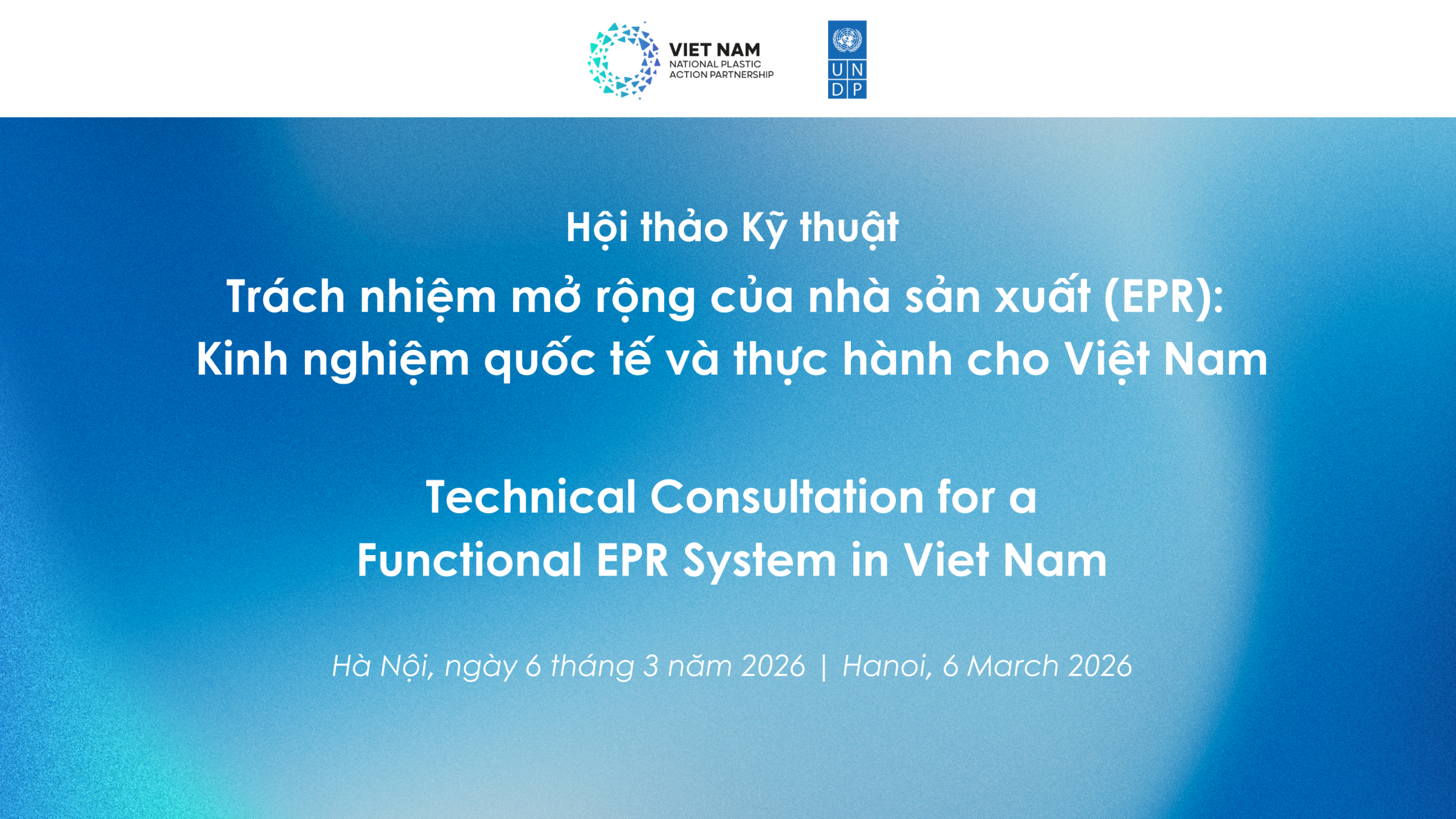
2.1. Tentative date and time: 6 March 2026
2.2. Tentative location: Van Mieu room, Pullman hotel, 40 Cat Linh Street, Hanoi
2.3. Format: hybrid format
- Participants
- Members of the NPAP Policy Task Force, and other Task Force members
- Representatives from other relevant ministries, associations, NGOs, academic institution, businesses, and other members of the NPAP communities
- Related businesses and associations
Tentative Agenda
| Time | Key Focus / Speakers | Speakers |
| 08:00 – 08:10 | Opening remarks by UNDP
Welcome remarks by Vietnam Environment Agency (VEA), MAE |
|
| Session 1: Experience Sharing: Global & Regional Insights
Facilitator: Mr. Hoang Thanh Vinh, UNDP Programme Analyst |
||
| 08:10 – 08:25 | EPR governance model for high recovery rates in Canada | Mr. Ben Routledge & Ms Madeleine Myhill – Canada EPR Experts |
| 08:25 – 08:40 | Turning EPR Fees into Verified Impact | Ms. Vigil Yu – Senior Program Officer of Verra |
| 08:40 – 08:55 | EPR Lessons: Producer Responsibility Organizations | Ms. Anke Boykin – Senior Director of Global Environmental Policy – PepsiCo Global |
| 08:55 – 09:10 | Designing for adoption – Key choices in Philippines EPR policy | Mr. Jepp Parales – Environmental Management Bureau (EMB) of Department of Environment and Natural Resources (DENR) of the Philippines |
| 09:10 – 09:50 | Reflections & Discussion | Facilitator: Mr. Hoang Thanh Vinh – UNDP Programme Analyst |
| 09:50 – 10:00 | Coffee break | |
| Session 2: Deep Dive: Revising Viet Nam’s EPR Regulation (Articles 54 & 55)
Facilitator: Mr. Ho Kien Trung, Deputy Director General of VEA |
||
| 10:00 – 10:15 | Presentation: Directions for EPR policy revision | Mr. Do Xuan Thuan – Officer of EPR Office |
| 10:15 – 11:00 | Technical Discussion on Article 54 | All participants |
| 11:00 – 11:50 | Technical Discussion on Article 55 | All participants |
| 11:50 – 12:00 | Plenary & Closing
Summary of recommendations for the revision phase and closing remarks |
UNDP & VEA |